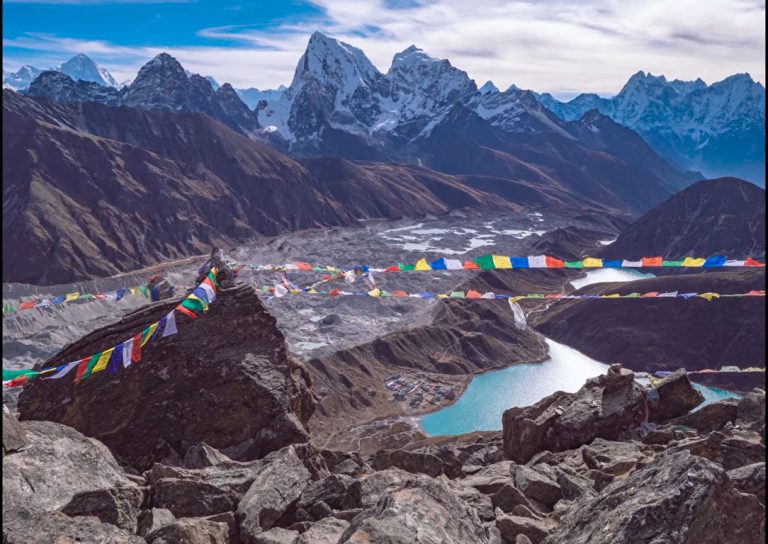
I still remember the exact moment it happened. Day nine, somewhere around 5 a.m., I stepped out of the tea house in Gorak Shep into air so cold it felt like breathing glass. The sky was doing something I had never seen before — a deep indigo fading into burnt orange directly above the peak of Everest, the summit catching the first light of the day while everything else was still dark. I had guided this trek maybe forty times by then. I still stopped walking and just stood there.
That is what Everest Base Camp does to you. Not just once — every single time.
What the trek actually looks like
Most people fly into Lukla from Kathmandu — a 35-minute flight that lands at one of the world’s most dramatic airstrips, a short runway cut into a hillside at 2,860 metres with a cliff at one end and a mountain at the other. From there the route follows the Dudh Koshi river valley north, climbing gradually through rhododendron and pine forests toward the Sherpa heartland of the Khumbu region.
The classic itinerary takes 12 to 14 days return. Two acclimatisation days are built in — one in Namche Bazaar (3,440m) and one higher up, usually at Dingboche or Pheriche. These aren’t optional rest days for the unfit. They are the difference between reaching base camp and being evacuated by helicopter. Everyone needs them, regardless of fitness level.

Namche Bazaar — the town that surprises everyone
Most trekkers arrive in Namche expecting a small mountain village and find something closer to a proper town. There are coffee shops, bakeries, gear shops, even a couple of bars. The Saturday market draws Tibetan traders who cross the border with yaks loaded with goods. You can eat momo dumplings, get your boots resoled, and buy a SIM card all in the same afternoon.
But Namche earns its reputation for a different reason: the first morning you wake up here, if the skies are clear, you step outside and Everest is sitting right there above the valley rim. A lot of people don’t expect that. They’ve been walking through forest for two days and suddenly there it is — the world’s highest mountain filling the horizon. It tends to make everyone go quiet.

The high valley: Tengboche to Gorak Shep
Above Namche the landscape changes dramatically. Trees thin out and disappear. The air gets noticeably thinner. The valley opens up and you start to see the peaks properly — Ama Dablam appearing to your right like it was placed there by a set designer, ridiculously photogenic at every angle. Tengboche Monastery at 3,867m is one of the most atmospheric places on the whole route: the oldest monastery in the Khumbu, with the mountains as a backdrop, the smell of juniper incense drifting out through the heavy wooden doors.
From Tengboche you push higher through Pheriche and Lobuche until you reach Gorak Shep at 5,164m — the last village on the route. It is a rough place. A handful of tea houses, no running water, the ground frozen solid by mid-afternoon. Meals are slow because cooking at this altitude is slow. The air at night gets down to -20°C in winter months. But from here, base camp is just three hours away.

Reaching Everest Base Camp
Base camp itself is not a summit. There is nothing to stand on top of. What you find is an extraordinary jumble of coloured tents spread across the Khumbu Glacier at 5,364m — the advance base for all Everest summit attempts via the south col route. During spring climbing season (March to May) there can be over 1,000 people camped here. Off-season it is deserted, just ice and rock and the constant groaning sound of a glacier moving under your feet.
Most people find the experience unexpectedly emotional. There is something about actually being there — not looking at a photo, not watching a documentary — that gets to people in ways they don’t predict. We’ve guided doctors, soldiers, marathon runners, and 60-year-old grandmothers to this spot. Nearly all of them cry.
Kala Patthar: the view that beats them all
Most experienced guides will tell you the same thing: the summit of Kala Patthar (5,545m) — a rocky knoll above Gorak Shep — gives a better view of Everest than base camp itself. From here you can see the peak cleanly, with Nuptse, Lhotse and the whole Khumbu icefall in one frame. The standard move is to leave Gorak Shep at 3 or 4 a.m. with headlamps, reach the summit for sunrise, and watch the light turn the mountain gold before descending for breakfast. Cold, slow and completely worth it.
What it really costs
| Item | Approx. cost |
| IATE guided package (all inclusive) | From USD 1,150 per person |
| Sagarmatha National Park permit | NPR 3,000 (~USD 22) |
| TIMS card | USD 20 |
| Lukla flight (each way) | USD 180–220 |
| Tea house meals (budget) | USD 15–25 per day |
| Travel insurance (mandatory) | USD 80–150 |
Practical things nobody tells you
Phone charging costs money in the high lodges — usually NPR 200–300 per charge. Carry a power bank. Wi-Fi exists above Namche but gets slower and more expensive the higher you go. Yarchagumba, the caterpillar fungus harvested in the high valleys, is on sale everywhere from Namche upward and is genuinely fascinating to look at even if you don’t buy any.
The food at the lodges is remarkably good given where you are. Dal bhat — lentil soup, rice, vegetables, usually with a fried egg on top — is the standard meal and almost always the best value. Some lodges in Namche and Dingboche do pizza and pasta that is surprisingly decent. Avoid the yak steak. It is always overcooked and you’ll feel bad about it.
Ready to go to Everest Base Camp?
IATE has been guiding EBC treks since 1996. Our guides know this route the way most people know their own neighbourhood — every lodge, every shortcut, every good morning view. Contact us and we will put together a personalised plan within 24 hours.